

Automotive Electronics Control Unit (ECU) Market to Reach USD 158.9 Billion by 2036 Amid Rising EV and ADAS Integration
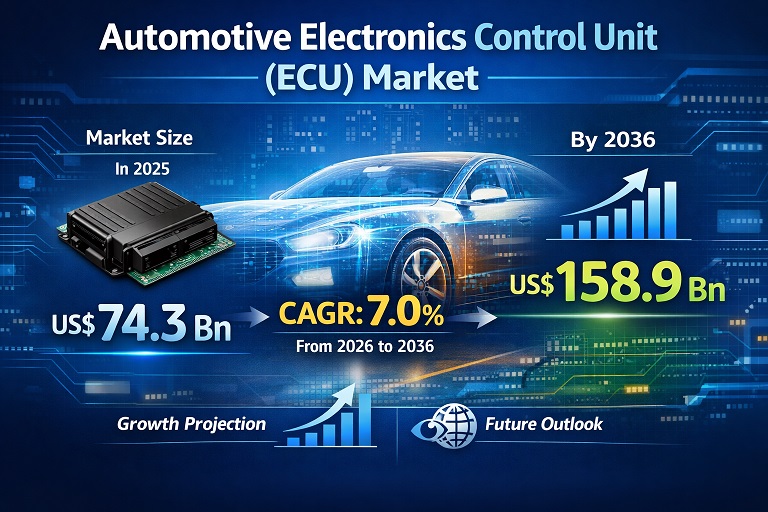
Automotive Electronics Control Unit (ECU) Market
The automotive electronics control unit (ECU) market is projected to reach US$ 158.9 Bn by the end of 2036”
WILMINGTON, DE, UNITED STATES, February 13, 2026 /EINPresswire.com/ -- The global Automotive Electronics Control Unit (ECU) Market was valued at approximately USD 74.3 billion in 2025 and is projected to reach around USD 158.9 billion by 2036, expanding at a CAGR of 7.0 % during the forecast period. Growth is primarily driven by the rapid electrification of vehicles, increasing integration of advanced driver assistance systems (ADAS), rising demand for connected car technologies, and stringent government safety regulations. — By Transparency Market Research
As modern vehicles integrate more sophisticated electronic systems, ECUs have become fundamental to vehicle operation, performance, diagnostics, and driver experience. Automotive manufacturers and suppliers are investing significantly in next-generation ECU platforms that support complex functions such as battery management, advanced driver assistance systems (ADAS), powertrain optimization, and infotainment integration.
Get Instant Access to the Sample Report – Start Exploring: https://www.transparencymarketresearch.com/sample/sample.php?flag=S&rep_id=86926
Battery Management Systems (BMS) for electric vehicles
ECUs serve as the “brains” behind critical vehicle systems by processing sensor data, executing control algorithms, and ensuring reliability and safety across mechanical and electrical components.
Key Growth DriverElectrification and Hybridization: The rise of electric vehicles (EVs) and hybrid powertrains is driving demand for advanced ECUs that manage battery performance, regenerative braking, power distribution, and thermal systems. Battery Management Systems (BMS) and dedicated EV control units represent one of the fastest-growing ECU segments globally.
Key Players:
• ZF Friedrichshafen AG
• PHINIA Inc.
• Robert Bosch GmbH
• Autoliv AB
• AUMOVIO SE
• Denso Corporation
• Infineon Technologies AG
• Aptiv
• Mitsubishi Electric Corporation
• Transtron Inc.
• Hitachi, Ltd.
• Syrma SGS
• Panasonic Corporation
• MicroAutotech
• NXP Semiconductors
• Siemens
• Other Prominent Players
Autonomous and ADAS Technologies: Advanced Driver Assistance Systems (ADAS) such as adaptive cruise control, lane-keep assist, collision avoidance, and automated emergency braking rely on high-performance ECUs capable of real-time data processing. The push toward Level 3 and higher autonomy will further accelerate ECU complexity and unit per vehicle growth.Connectivity and Telematics: Connected vehicles require robust telematics control units that link vehicles with cloud servers, mobile devices, and infrastructure. ECUs that support over-the-air (OTA) updates, vehicle-to-everything (V2X) communication, and cybersecurity are becoming integral components of modern vehicles.
Regulatory Safety Standards: Government mandates for safety features like electronic stability control, anti-lock braking systems (ABS), and airbag deployment systems are expanding ECU adoption. Additionally, emissions and fuel economy regulations are driving demand for precision-control ECUs that optimize combustion and energy use.
Infotainment and User Experience: Consumer expectations for seamless digital experiences—touchscreens, voice interfaces, navigation, and personalization—are contributing to growth in infotainment and human-machine interface (HMI) ECUs.
Get this premium report for strategic insights: https://www.transparencymarketresearch.com/checkout.php?rep_id=86926<ype=S
Market Segmentation
Type
• Engine Control Unit (ECU)
• Transmission Control Unit (TCU)
• Body Control Module (BCM)
• Battery Management System (BMS) ECU
• Powertrain Control Module (PCM)
• Safety ECU
• HVAC Control Unit
• ADAS Control Unit
• Others (Convenience ECU, Steering ECU, etc.)
Capacity
• 08-bit ECU
• 16-bit ECU
• 32-bit ECU
• 64-bit ECU
Autonomy Level
• Conventional (L0-L1)
• Semi-Autonomous (L2-L3)
• Autonomous (L4-L5)
Vehicle Type
• Two-Wheelers
• Passenger Cars
• Commercial Vehicles
• Off-Highway Vehicles
Propulsion Type
• Internal Combustion Engine (ICE)
• Battery Electric Vehicle (BEV)
• Fuel Cell Electric Vehicle (FCEV)
• Plug-in Hybrid Electric Vehicles (PHEV)
Sales Channel
• OEMs
• Aftermarket
Emerging Trends
Software-Defined Vehicles (SDVs): OEMs are transitioning toward software-centric architectures where ECUs serve as nodes in a distributed computing network. SDVs enable feature enhancements through software updates rather than hardware changes, prolonging product life and enhancing user experience.
Domain Control Units: Rather than traditional multiple ECUs per function, automakers are consolidating functionality into centralized domain control units (DCUs) for powertrain, ADAS, and cockpit systems. This streamlining reduces complexity, cost, and vehicle weight.
Enhanced Cybersecurity: As ECUs connect to external networks, cybersecurity has become a priority. Manufacturers are embedding secure elements and encryption capabilities into control units to prevent unauthorized access and data breaches.
Artificial Intelligence (AI) Integration: AI and machine learning are being incorporated into ECU algorithms, particularly for predictive maintenance, anomaly detection, and adaptive ADAS behavior.
Functional Safety Standards: Compliance with ISO 26262 and other functional safety standards is shaping ECU design, requiring redundancy, fault-tolerance, and real-time diagnostic capabilities.
Regional Insights
Asia Pacific: China, India, Japan, and South Korea are major hubs for ECU production and adoption due to strong vehicle manufacturing and government
support for EVs and smart mobility.
Europe: Europe’s stringent emissions and safety regulations, coupled with high penetration of premium vehicles, are propelling investments in advanced
ECU technologies.
North America: The U.S. and Canada are witnessing rapid ECU innovation driven by autonomous driving development, connected vehicles, and electric
vehicle incentives.
Rest of World: Latin America and the Middle East & Africa are gradually increasing ECU adoption with improving automotive infrastructure and rising consumer demand for advanced vehicle features.
Challenges
Despite strong growth prospects, the market faces challenges such as:
Component Shortages: Fluctuations in semiconductor supply chains can impact ECU production timelines.
Cost Pressures: Increasing vehicle electronics content may elevate production costs, requiring efficiency enhancements.
Regulatory Complexity: Harmonizing global safety and emissions standards remains a challenge for OEMs and suppliers.
Opportunities Ahead
Electric Vehicle Boom: Rapid EV penetration presents significant opportunities for specialized ECUs tailored to battery systems, propulsion control, and energy management.
Mobility Services: Shared and autonomous mobility platforms will require scalable control unit solutions that support fleet management, predictive diagnostics, and remote connectivity.
Aftermarket Growth: Retrofitting and ECU updates in older vehicles represent a growing aftermarket opportunity, particularly in regions with long vehicle lifecycles.
Frequently Asked Questions (FAQ)
1. How big was the automotive electronics control unit (ECU) market in 2025?
The automotive electronics control unit (ECU) market was valued at US$ 74.3 Bn in 2025
2. How big will the automotive electronics control unit (ECU) business be in 2036?
The automotive electronics control unit (ECU) market is projected to reach US$ 158.9 Bn by the end of 2036
3. What are the factors driving the automotive electronics control unit (ECU) market?
Growing electrification of vehicles (EVs and HEVs); and expansion of connected and software-defined vehicles
4. What will be the CAGR of the automotive electronics control unit (ECU) industry during the forecast period?
The CAGR is anticipated to be 7.0% from 2026 to 2036
5. Which region will account for a major share of the automotive electronics control unit (ECU) sector during the forecast period?
Asia Pacific is expected to account for the largest share from 2026 to 2036
More Trending Reports by Transparency Market Research –
Electric Vehicle Motor Market - https://www.transparencymarketresearch.com/electric-vehicle-motor-market.html
Automotive Power Electronics Market - https://www.transparencymarketresearch.com/automotive-power-electronics-market.html
EV Range Extender Market - https://www.transparencymarketresearch.com/electric-vehicle-range-extender-market.html
Abhishek Budholiya - Marketing Team
Transparency Market Research Inc.
+ +1 518-618-1030
email us here
Legal Disclaimer:
EIN Presswire provides this news content "as is" without warranty of any kind. We do not accept any responsibility or liability for the accuracy, content, images, videos, licenses, completeness, legality, or reliability of the information contained in this article. If you have any complaints or copyright issues related to this article, kindly contact the author above.
