

Farm Scale Protein Market to Reach USD 42,300.1 Mn by 2035, Growing at 6.1% CAGR | Transparency Market Research
Farm Scale Protein Market
Farm Scale Protein Market is projected to reach USD 42,300.1 Mn by 2035, fueled by rising plant-based protein demand and precision agri-biotech advancements
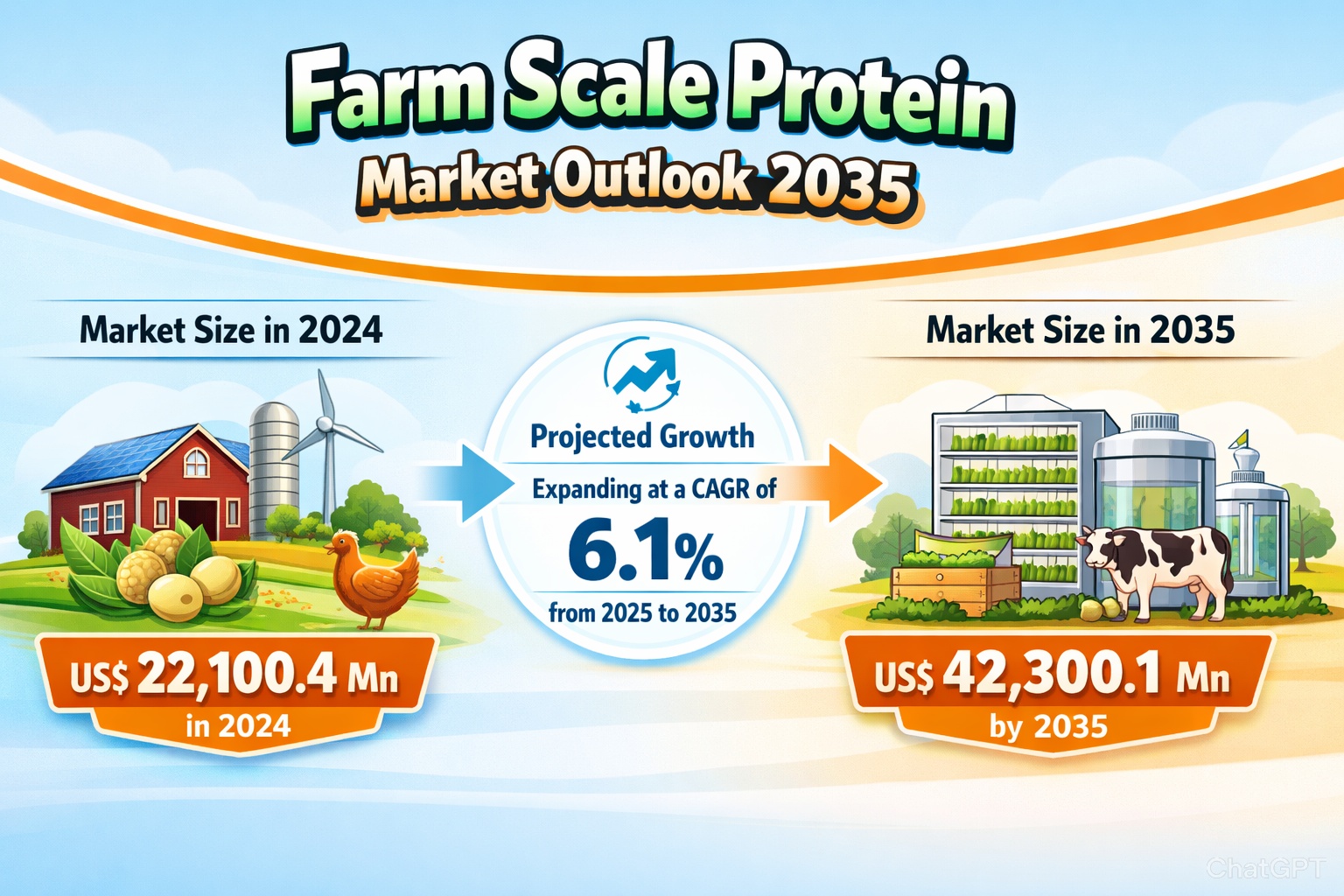
WILMINGTON, DE, UNITED STATES, February 23, 2026 /EINPresswire.com/ -- Farm Scale Protein MarketThe global Farm Scale Protein market is experiencing steady expansion as the agriculture and food industries undergo structural transformation toward decentralized and sustainable protein production. Valued at US$ 22,100.4 Mn in 2024, the market is projected to reach US$ 42,300.1 Mn by 2035, registering a compound annual growth rate (CAGR) of 6.1% from 2025 to 2035.
Explore pivotal insights and conclusions from our Report in this sample –
https://www.transparencymarketresearch.com/sample/sample.php?flag=S&rep_id=86879
This growth trajectory reflects the rising global demand for plant-based and alternative protein sources, increasing pressure on traditional livestock-based protein supply chains, and rapid technological advancements in precision fermentation and agri-biotechnology. As food security, sustainability, and local production gain prominence, farm-scale protein systems are emerging as a viable and scalable solution.
North America currently dominates the global landscape, accounting for approximately 35% of total revenue share in 2024, while pulses lead the source segment with 52.9% market share, underlining the strong preference for high-protein, sustainable crop sources.
Market Overview
The Farm Scale Protein market represents a transformative shift in protein production models. Traditionally, protein extraction and processing were concentrated in centralized industrial plants and large-scale bioreactors. However, modern farm-scale protein systems enable decentralized production directly at or near farming sites.
These systems encompass:
• Precision fermentation units
• Insect farming platforms
• Algae cultivation systems
• Microbial protein production modules
• On-site protein extraction from pulses and grains
By integrating biotechnology with agriculture, farm operators can now produce high-quality proteins—including animal feed proteins, functional food proteins, nutraceutical-grade inputs, and specialty biomolecules—within smaller, modular systems.
This shift offers multiple advantages:
• Reduced dependence on international supply chains
• Lower transportation emissions
• Improved traceability and freshness
• New revenue streams for farmers
• Better alignment between crop cultivation and protein processing
The farm-scale protein model also addresses mounting environmental and sustainability concerns linked to conventional livestock protein production, including greenhouse gas emissions, water usage, and land degradation.
As global demand for alternative proteins continues to accelerate, the integration of agriculture and biotechnology is reshaping the global protein ecosystem.
Key Market Growth Drivers
1. Rising Demand for Plant-Based and Alternative Proteins
A structural shift in consumer dietary patterns is fueling demand for plant-derived proteins. Health-conscious consumers are reducing animal protein intake and increasing consumption of pulses, grains, seeds, and legumes.
Key contributing factors include:
• Growing awareness of cardiovascular and metabolic health
• Rising vegan and flexitarian populations
• Demand for clean-label and minimally processed foods
• Corporate sustainability commitments
• ESG-driven food sourcing strategies
Farm-scale production ensures localized sourcing and processing of protein-rich crops such as peas, lentils, chickpeas, and soy, strengthening supply reliability while reducing environmental impact.
2. Technological Advancements in Precision Fermentation & Agri-Biotech
Innovations in strain engineering and microbial optimization are accelerating protein production efficiency. Advanced fermentation systems now use engineered yeasts, bacteria, and fungi to produce specific proteins identical to those derived from animal sources.
Key technological enablers include:
• AI-driven metabolic pathway optimization
• Automated bioreactors with real-time monitoring
• pH, temperature, oxygen, and nutrient control systems
• Improved strain safety and toxin pathway elimination
• Yield maximization and variance reduction tools
These advancements enable smaller-scale, on-farm bioreactor installations, making protein production economically viable at decentralized levels.
3. Sustainability and Food Security Concerns
Climate change, supply chain disruptions, and geopolitical tensions have exposed vulnerabilities in centralized food systems. Farm-scale protein systems enhance resilience by:
• Localizing production
• Reducing import dependency
• Improving food security
• Lowering carbon footprint
Governments worldwide are supporting alternative protein initiatives to reduce pressure on livestock agriculture.
Analysis of Key Players – Key Player Strategies
The competitive landscape is shaped by established multinational food and agribusiness corporations investing heavily in alternative and plant-based proteins.
Key players include:
ADM
Abbott Laboratories
Cargill, Incorporated
Danone S.A.
Emsland Group
Glanbia plc
JBS S.A.
Kerry Group plc
Oatly Group AB
Roquette Frères S.A.
The Kraft Heinz Company
Tyson Foods, Inc.
Unilever PLC
Wilmar International Ltd.
Other Key Players
Core Strategies Adopted by Leading Players
1. Portfolio Diversification into Plant-Based Proteins
Companies are expanding beyond traditional animal proteins into pulse-derived, microbial, and fermentation-based protein portfolios.
2. Strategic Acquisitions & Investments
Acquiring specialized plant-based and precision nutrition companies to accelerate innovation and market penetration.
3. Vertical Integration
Integrating farming operations with processing infrastructure to enhance efficiency and traceability.
4. Sustainability Positioning
Investing in low-carbon production systems and ESG reporting frameworks.
5. R&D Expansion
Strengthening innovation pipelines in strain development, fermentation optimization, and protein extraction technologies.
Explore the highlights and essential data from our Report in this sample –
https://www.transparencymarketresearch.com/sample/sample.php?flag=S&rep_id=86879
Market Challenges & Opportunities
Key Challenges
• High initial capital expenditure for bioreactors and precision systems
• Regulatory complexities for novel proteins
• Farmer skill gaps in biotech system management
• Price sensitivity in emerging markets
• Competition from centralized industrial protein producers
Key Opportunities
• Government subsidies for sustainable farming
• Expansion of organic farming systems
• Growth in nutraceutical and pharmaceutical protein demand
• Increased venture capital interest in agri-biotech
• Export potential for protein-rich crops
Emerging markets in Asia Pacific and Latin America present untapped opportunities due to large agricultural bases and growing plant-based consumption trends.
Recent Developments
In July 2025, Danone completed its acquisition of a majority stake in Kate Farms, a U.S.-based plant-based nutrition company. The deal expands Danone’s specialized nutrition portfolio and strengthens its presence in the fast-growing plant-based protein market, enhancing its offerings in medical and wellness nutrition.
In April 2025, Cargill won five Edison Awards for innovations in food and agriculture, including next-generation protein, clean-label preservation, and poultry-farming tools, highlighting the company’s leadership in advancing protein production technologies and promoting sustainable, efficient, and future-ready food systems globally.
Investment Landscape and ROI Outlook
The Farm Scale Protein market is attracting strong investor interest due to its:
• Stable CAGR of 6.1%
• Long-term sustainability alignment
• Decentralized scalability
• Expanding application scope
Investment is flowing into:
• Modular fermentation technology providers
• On-farm protein extraction equipment manufacturers
• AI-enabled bioprocessing startups
• Sustainable crop development
ROI potential is supported by:
• Reduced logistics costs
• Premium pricing for sustainable proteins
• Government incentives
• Carbon credit monetization
Institutional investors and agribusiness funds view farm-scale protein as a medium- to long-term strategic growth opportunity aligned with global food system transformation.
Market Segmentations
By Source
• Pulses (Soya, Peas, Lentils, Chickpeas, Others)
• Nuts & Seeds (Almonds, Walnuts, Chia Seeds, Others)
• Grains & Cereals (Oats, Quinoa & Amaranth, Wheat, Others)
• Others (Vegetables, Algae, etc.)
By Category
• Traditional Farming
• Organic Farming
By Scale of Operation
• Micro-scale (<10 ha)
• Small Commercial (10–100 ha)
• Medium Farms (100–1,000 ha)
• Industrial / Corporate Farms (>1,000 ha)
By Protein Level
• Low (Up to 10 g per 100 g)
• Medium (11–20 g per 100 g)
• High (Above 20 g)
By End-Use Industry
• Human Food
• Animal Feed
• Industrial & Specialty
• Nutraceuticals
• Pharmaceutical
• Others
By Region
• North America (U.S., Canada)
• Europe (U.K., Germany, France, Italy, Spain, Netherlands)
• Asia Pacific (China, India, Japan, South Korea, Australia, ASEAN)
• Middle East & Africa (GCC Countries, South Africa)
• Latin America (Brazil, Mexico, Argentina)
Why Buy This Report?
• Comprehensive market size and forecast analysis (2020–2035)
• In-depth segment and regional insights
• Detailed competitive landscape and strategy analysis
• Identification of emerging investment hotspots
• Coverage of technological trends in precision fermentation
• ESG and sustainability impact evaluation
• Company profiling with financial overview and recent developments
This report provides actionable intelligence for investors, agribusiness operators, equipment manufacturers, policymakers, and protein producers.
Buy this Premium Research Report for actionable insights and key takeaways –
https://www.transparencymarketresearch.com/checkout.php?rep_id=86879<ype=S
Frequently Asked Questions
1. What is the projected size of the Farm Scale Protein market by 2035?
The market is expected to reach US$ 42,300.1 Mn by 2035.
2. What is driving the growth of the market?
Key drivers include rising demand for plant-based proteins and advancements in precision fermentation and agri-biotechnology.
3. Which region leads the market?
North America currently holds the largest revenue share at approximately 35%.
4. Which source segment dominates the market?
Pulses lead the market, accounting for 52.9% of total share in 2024.
5. What industries use farm-scale proteins?
Major end-use industries include human food, animal feed, nutraceuticals, pharmaceuticals, and industrial specialty applications.
Browse More Trending Research Reports
Refrigerated Warehousing Market - https://www.transparencymarketresearch.com/refrigerated-warehousing-market.html
Cold Storage Equipment Market - https://www.transparencymarketresearch.com/cold-storage-equipment-market.html
Solar-Powered Cold Storage Market - https://www.transparencymarketresearch.com/solar-powered-cold-storage-market.html
Automated Sample Storage Systems Market - https://www.transparencymarketresearch.com/automated-sample-storage-systems-market.html
About Us Transparency Market Research
Transparency Market Research, a global market research company registered at Wilmington, Delaware, United States, provides custom research and consulting services. The firm scrutinizes factors shaping the dynamics of demand in various markets. The insights and perspectives on the markets evaluate opportunities in various segments. The opportunities in the segments based on source, application, demographics, sales channel, and end-use are analysed, which will determine growth in the markets over the next decade.
Our exclusive blend of quantitative forecasting and trends analysis provides forward-looking insights for thousands of decision-makers, made possible by experienced teams of Analysts, Researchers, and Consultants. The proprietary data sources and various tools & techniques we use always reflect the latest trends and information. With a broad research and analysis capability, Transparency Market Research employs rigorous primary and secondary research techniques in all of its business reports.
Contact Us
Transparency Market Research Inc.
CORPORATE HEADQUARTER DOWNTOWN,
1000 N. West Street,
Suite 1200, Wilmington, Delaware 19801 USA
Tel: +1-518-618-1030
USA - Canada Toll Free: 866-552-3453
Abhishek Budholiya - Marketing Team
Transparency Market Research Inc.
+1 518-618-1030
email us here
Legal Disclaimer:
EIN Presswire provides this news content "as is" without warranty of any kind. We do not accept any responsibility or liability for the accuracy, content, images, videos, licenses, completeness, legality, or reliability of the information contained in this article. If you have any complaints or copyright issues related to this article, kindly contact the author above.
