

Wine Bag Industry Outlook 2026–2036: Global Market to Reach USD 228.6 Million by 2036 at 4.2% CAGR
Wine Bag Market
U.S. wine bag demand is set to grow at 4.5% CAGR through 2036, driven by plastic bag bans like California’s SB 1053 eliminating checkout plastics.
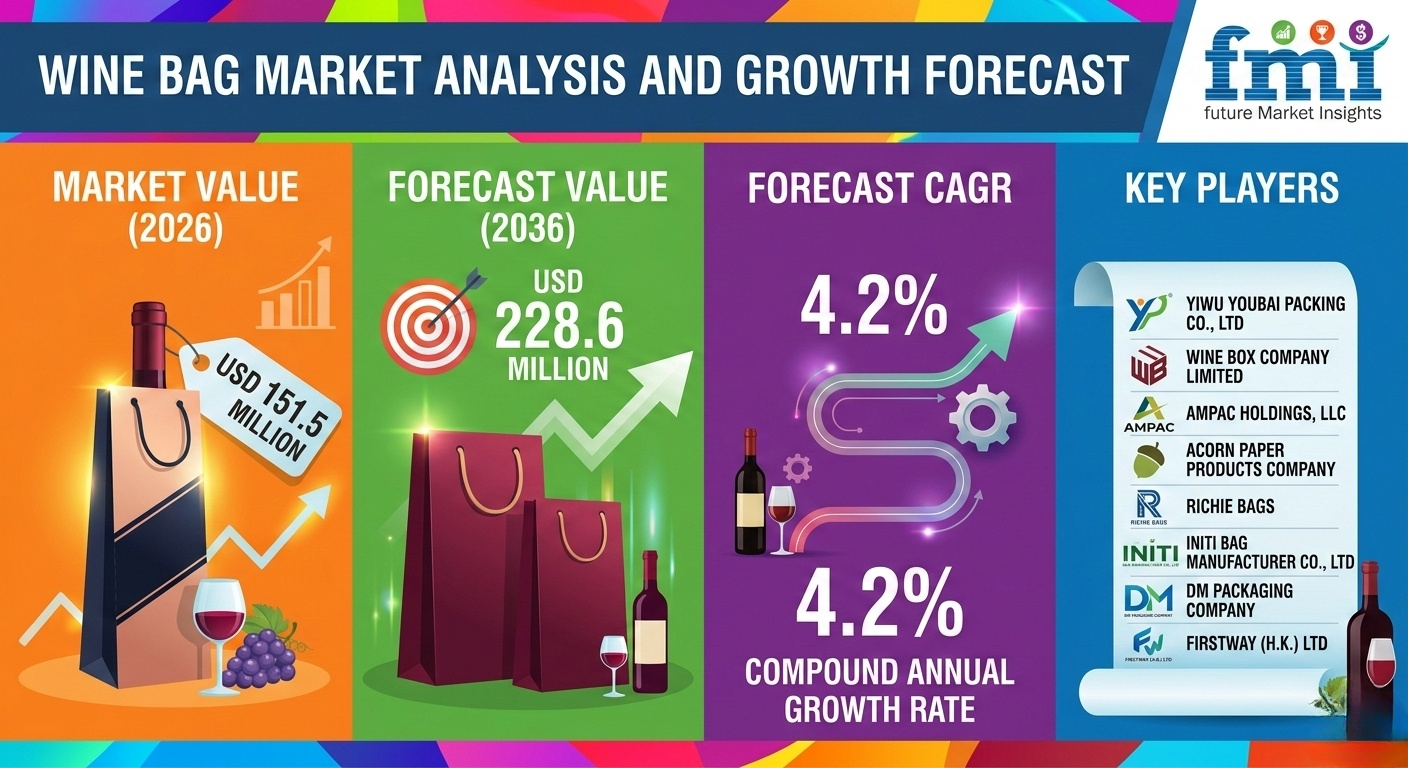
NEWARK, DE, UNITED STATES, March 20, 2026 /EINPresswire.com/ -- The global wine bag market is entering a phase of strategic recalibration, where sustainability mandates, retail transformation, and premium gifting culture are reshaping demand dynamics. Valued at USD 145.5 million in 2025, the market is projected to reach USD 151.5 million in 2026 and expand further to USD 228.6 million by 2036, registering a compound annual growth rate (CAGR) of 4.2% over the forecast period.
This measured yet resilient growth trajectory reflects a structural shift rather than volume-driven expansion. According to Future Market Insights (FMI), the wine bag ecosystem is transitioning from a commoditized packaging segment into a value-driven, sustainability-aligned industry where material innovation and branding potential dictate competitive advantage.
Discover Growth Opportunities in the Market – Get Your Sample Report Now
https://www.futuremarketinsights.com/reports/sample/rep-gb-2894
The Structural Shift: Packaging Migration Over Consumption Growth
Unlike traditional packaging markets tied directly to consumption volumes, the wine bag sector is being propelled by packaging substitution trends. Absolute dollar growth of USD 76.0 million over the next decade highlights how regulatory pressure on single-use plastics and retailer-led sustainability initiatives are driving a migration toward reusable and premium formats.
Manufacturers are increasingly moving away from low-margin disposable plastic bags toward fabric-based and reusable alternatives, which command higher price points and align with evolving environmental standards.
The Materiality Shift: From Utility to Brand Asset
Wine bags are no longer just carriers—they are becoming brand extensions and experiential packaging tools. The industry is witnessing a clear pivot toward materials that combine durability, aesthetics, and sustainability.
• Fabric wine bags dominate the market with a 49.2% share, driven by their reusability and premium positioning
• Retailers are embedding these bags into sustainability programs, reframing them as long-term brand assets
• Cotton and jute materials are gaining traction due to durability and eco-certification compatibility
This transformation is further reinforced by global retail initiatives promoting reusable shopping alternatives, where wine bags are increasingly standardized as part of the broader anti-plastic movement.
Evolving Demand Drivers: Sustainability Meets Lifestyle
The wine bag market is being reshaped by a convergence of macro and micro demand drivers:
• Retail Plastic Reduction Mandates: Government regulations across North America and Europe are accelerating the decline of single-use plastic wine carriers
• Gifting Culture Expansion: Rising wine consumption in Asia-Pacific is accompanied by a surge in demand for aesthetically appealing packaging
• Hospitality Sector Adoption: Hotels and restaurants are deploying branded reusable wine bags to enhance takeaway and in-room service experiences
Together, these factors are redefining wine bags as functional, sustainable, and marketing-driven packaging solutions.
Segment Spotlight: Reusability and Single-Bottle Dominance
Product Type Leadership
Reusable wine bags command 63.0% of total market share, supported by retailer incentive programs and consumer preference for sustainable options.
Capacity Trends
Single-bottle wine bags dominate with 61.0% share, reflecting their strong alignment with:
• Premium gifting occasions
• Impulse retail purchases
• Luxury product positioning
The emphasis on single-unit presentation underscores how packaging aesthetics directly influence perceived product value, particularly in high-end wine segments.
Regional Outlook: Asia-Pacific Emerges as Growth Engine
While mature markets continue to provide steady demand, emerging economies are driving incremental growth.
India (5.2% CAGR)
India represents a high-potential growth market, fueled by:
• Expanding urban wine consumption
• Rapid growth in hospitality and premium dining
• Industry-wide elimination of single-use plastics
China (4.8% CAGR)
China’s market is shaped by premiumization and gifting culture, where wine packaging plays a critical role in brand perception and social signaling.
United States (4.5% CAGR)
The U.S. remains a regulatory catalyst, with strict plastic bag bans compelling retailers to adopt compliant reusable alternatives, thereby accelerating demand for fabric wine bags.
Europe (3.6%–3.9% CAGR)
Countries like France and Germany are driven by circular economy mandates, where reuse targets and extended producer responsibility frameworks are shaping packaging innovation.
Dynamics of the Decade: Sustainability and Premiumization
Looking toward 2036, several transformative trends are expected to define the competitive landscape:
Eco-Driven Innovation
Manufacturers are investing in biodegradable materials, organic fabrics, and certified supply chains to meet retailer and regulatory requirements.
Retail Integration Strategies
Wine bags are increasingly being integrated into retail sustainability programs, turning packaging into a recurring revenue stream rather than a one-time purchase.
Direct-to-Consumer Disruption
The rise of online wine delivery is reshaping packaging demand, potentially reducing multi-bottle bag usage while increasing focus on premium single-bottle formats.
Dual-Use Design Evolution
Manufacturers are designing wine bags with multi-purpose functionality, enabling reuse beyond wine transport and justifying higher price points.
Competitive Landscape: Fragmented Yet Strategically Concentrated
The wine bag market remains fragmented at the surface but is strategically concentrated among suppliers capable of meeting scale, sustainability compliance, and customization requirements.
Key competitive dynamics include:
• Procurement Consolidation: Approximately 60% of demand flows through structured retail contracts
• Supplier Differentiation: Companies with direct textile sourcing maintain cost stability and margin resilience
• Sustainability Certification: Compliance with standards such as organic and fair-trade certifications is becoming a prerequisite for large retail tenders
Major players are increasingly focusing on long-term contracts, co-branded programs, and material innovation to secure market share.
Strategic Takeaways for Industry Stakeholders
• Invest in Fabric Capacity: Regulatory trends strongly favor reusable materials over disposable formats
• Leverage Retail Partnerships: Co-branded sustainability programs can secure consistent demand
• Focus on Premium Design: Aesthetic differentiation is critical in driving consumer willingness to pay
• Align with Hospitality Demand: Branded reusable bags offer recurring revenue opportunities in hotels and restaurants
Recent Industry Developments
• Strategic acquisitions are enabling companies to expand bespoke packaging capabilities and strengthen operational integration
• Innovations in sustainable materials, including recyclable and moisture-protective solutions, are enhancing product performance and lifecycle value
Key Players in the Wine Bag Market
• Yiwu Youbai Packing Co., Ltd
• Wine Box Company Limited
• Ampac Holdings, LLC
• Acorn Paper Products Company
• Richie Bags
• Initi Bag Manufacturer Co., Ltd
• DM Packaging Company
• Firstway (H.K.) Ltd
• NANGFA Manufacturing Co., Ltd
Why FMI: https://www.futuremarketinsights.com/why-fmi
Explore More Research Reports by FMI
Serialized Packaging for Confidential Products Market - https://www.futuremarketinsights.com/reports/serialized-packaging-for-confidential-products-market
Secure Document Packaging Market - https://www.futuremarketinsights.com/reports/secure-document-packaging-market
Old Corrugated Container (OCC) Market - https://www.futuremarketinsights.com/reports/old-corrugated-containers-market
Cloth-Based Packaging for Spiritual Products Market - https://www.futuremarketinsights.com/reports/cloth-based-packaging-for-spiritual-products-market
Antibacterial Film Market - https://www.futuremarketinsights.com/reports/antibacterial-film-market
About Future Market Insights (FMI)
Future Market Insights, Inc. (FMI) is an ESOMAR-certified, ISO 9001:2015 market research and consulting organization, trusted by Fortune 500 clients and global enterprises. With operations in the U.S., UK, India, and Dubai, FMI provides data-backed insights and strategic intelligence across 30+ industries and 1200 markets worldwide.
Sudip Saha
Future Market Insights Inc.
+1 347-918-3531
email us here
Legal Disclaimer:
EIN Presswire provides this news content "as is" without warranty of any kind. We do not accept any responsibility or liability for the accuracy, content, images, videos, licenses, completeness, legality, or reliability of the information contained in this article. If you have any complaints or copyright issues related to this article, kindly contact the author above.
