

Nickel Metal Hydride Battery Market Projected to Reach USD 5.19 Billion by 2035, Growing at 5.8% CAGR
Nickel Metal Hydride Battery Market
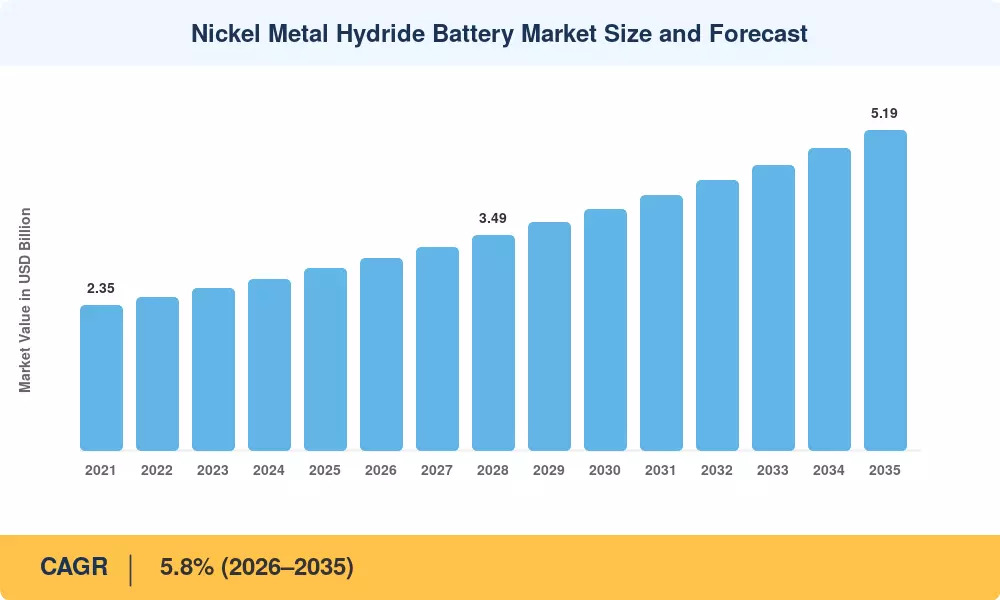
Nickel Metal Hydride (NiMH) Battery Market is projected to reach USD 5.19 Billion, at a 5.8% CAGR by 2035.
As Per the MRFR Analysis, Nickel Metal Hydride Battery Market is projected to reach USD 5.19 Billion, at a 5.8% CAGR by driving industry size, share, top company Analysis, and forecast report to 2035.”
NEW YORK, NY, UNITED STATES, August 24, 2026 /EINPresswire.com/ -- As Per the MRFR Analysis, Nickel Metal Hydride (NiMH) Battery Market is projected to reach USD 5.19 Billion, at a 5.8% CAGR by driving industry size, share, top company Analysis, segments research, trends and forecast report to 2035.— Prashant Hake
Market Overview
The Nickel Metal Hydride (NiMH) Battery Market encompasses rechargeable battery technology that uses a nickel oxyhydroxide positive electrode and a hydrogen-absorbing alloy negative electrode. NiMH batteries are valued for their safety profile, wide operating temperature range, and proven reliability, making them essential in hybrid electric vehicles (HEVs), consumer electronics, industrial backup power systems, medical devices, and telecommunications infrastructure.
This market trajectory is anchored in sustained demand from hybrid electric vehicle programs—Toyota alone delivered over 2.8 million HEV units globally in 2024—and expanding industrial energy storage applications where NiMH chemistry's safety profile and wide operating temperature range outperform alternatives [1]. Government mandates in Japan and the EU pushing fleet-average CO₂ reductions below 95 g/km continue to channel OEM investment into hybrid powertrains that rely heavily on NiMH battery packs [2]. The global HEV fleet, exceeding 25 million cumulative units by end-2024, generates both OEM and aftermarket demand for NiMH packs [1].
A quiet but important technology shift is reshaping the Nickel Metal Hydride Battery Market. While lithium-ion dominates headlines, NiMH cells have undergone meaningful improvements in energy density—reaching 100 Wh/kg in advanced prismatic formats—and cycle life now regularly exceeds 1,500 full discharge cycles [3]. Panasonic's 2024 announcement of a next-generation low-self-discharge NiMH platform, backed by an estimated USD 180 million R&D commitment, signals that manufacturers see a durable future for this chemistry in applications where abuse tolerance and recyclability matter more than gravimetric energy density [3].
Policy and regulatory influence continues to shape demand patterns. The EU Battery Regulation (Regulation 2023/1542) imposes minimum recycled-content requirements starting in 2031—6% for nickel and 16% for cobalt in new batteries [7]. NiMH chemistry benefits disproportionately because its recycling infrastructure is mature and recovery rates for nickel and rare-earth elements exceed 95% in modern hydrometallurgical processes [7]. Japan's METI has allocated ¥35 billion (approximately USD 240 million) through 2028 to support next-generation hybrid powertrain R&D, explicitly including advanced NiMH cell development as a qualifying technology [2].
The demand outlook for the Nickel Metal Hydride Battery Market remains positive. Asia-Pacific commands roughly 48% of the market, driven by Japan's legacy manufacturing base and China's expanding HEV production. North America holds an estimated 22% share, supported by consumer electronics demand and Toyota's Kentucky battery plant. Europe contributes approximately 20%, propelled by strict emissions standards and growing industrial backup power adoption. The decade ahead will see the market benefit from circular-economy regulations that favor NiMH's high recyclability rates over chemistries dependent on scarce raw materials [4].
📍 Get Free Sample Report for Detailed Market Insights:
https://www.marketresearchfuture.com/sample_request/22315
Market Segmentation
By Battery Type
The Nickel Metal Hydride Battery Market is segmented into Prismatic, Cylindrical, and Button/Coin cells. Prismatic NiMH cells hold an estimated 44% share of the market, driven by automotive OEM specifications for hybrid battery packs [1]. Toyota's standardized prismatic module format—used across Prius, Camry, and RAV4 Hybrid platforms—creates enormous production volumes that drive economies of scale, with Panasonic and PEVE (Primearth EV Energy) together supplying over 80% of global automotive prismatic NiMH cells [3].
Cylindrical cells are growing at a CAGR of 6.3% as consumer electronics and power tool applications expand capacity requirements [5]. Demand stems from consumer rechargeable batteries in AA and AAA form factors, cordless power tools, and emergency lighting systems. Low-self-discharge variants have transformed cylindrical NiMH from a niche product into a mainstream consumer staple, with global shipments exceeding 4.2 billion units in 2024 [5]. Button cells contribute approximately USD 210 million in revenue, serving medical devices and specialty instrumentation where compact form factors are essential.
By Application
The Nickel Metal Hydride Battery Market serves Automotive (HEV), Consumer Electronics, Industrial / UPS, Medical Devices, and Other (Rail, Defense) applications. Automotive applications account for roughly 52% of the market, reflecting the dominance of HEV powertrains [1]. Toyota—the single largest NiMH battery buyer globally—produced 3.4 million hybrid vehicles in fiscal year 2024, and its mid-term plan targets 5 million annual HEV units by 2030 [1]. Honda, Hyundai, and several Chinese OEMs maintain NiMH-equipped hybrid lines alongside their BEV portfolios.
Consumer electronics segments are projected to reach USD 1.18 billion by 2035, fueled by rechargeable AA/AAA replacement cycles [5]. Retailers report NiMH rechargeable batteries now represent 28% of primary-battery-replacement purchases in Japan and 18% in Western Europe. Industrial / UPS applications account for USD 485 million in 2025, driven by data center, hospital, and telecom backup where lithium-ion's thermal runaway risk is unacceptable [8]. Medical devices represent the fastest-growing application at a CAGR of 7.2%, as portable patient monitoring and surgical tools require high safety certification standards that NiMH's intrinsic thermal stability facilitates [10].
By End User
The Nickel Metal Hydride Battery Market serves Automotive OEMs, Consumer / Retail, Industrial Facilities, Healthcare Providers, and Government / Defense. Automotive OEMs represent the largest end-user segment at 48% share, driven by HEV production programs [1]. Consumer / Retail follows with a 5.6% CAGR, supported by retail rechargeable battery sales. Industrial Facilities account for USD 390 million in 2025, serving UPS, telecom, and emergency systems where safety-conscious operators specify NiMH for mission-critical backup [8]. Healthcare Providers and Government / Defense represent smaller but strategically important segments with stringent certification requirements.
By Region
Asia-Pacific commands roughly 48% of the Nickel Metal Hydride Battery Market, driven by Japan's legacy manufacturing base and China's expanding HEV production. North America holds an estimated 22% share, supported by consumer electronics demand and Toyota's Kentucky battery plant. Europe contributes approximately 20%, propelled by strict emissions standards and growing industrial backup power adoption. South America and the Middle East & Africa represent smaller but faster-growing segments at CAGRs of 5.5% and 6.0% respectively, driven by telecom tower electrification and off-grid storage applications [9].
🛒 You can buy this market report at:
https://www.marketresearchfuture.com/checkout?currency=one_user-USD&report_id=22315
Regional Analysis
Asia-Pacific
Asia-Pacific anchors the Nickel Metal Hydride Battery Market with 48% share, driven by Japan's legacy manufacturing base and China's expanding HEV production. Japan accounts for 38% of regional revenue, hosting Panasonic Energy's Tokushima and Shonan plants alongside FDK Corporation's Kosai facility, which together supply approximately 60% of global prismatic NiMH cells for automotive applications [3]. China follows with a 6.8% CAGR, as domestic HEV production expands—BYD and Geely both maintain NiMH-equipped hybrid lines—with Chinese cell manufacturers investing in rare-earth alloy integration to reduce import dependence on Japanese electrode materials [1]. South Korea and India contribute through Hyundai-Kia hybrid programs and telecom backup applications respectively, with India's market growing at a 7.1% CAGR [9].
North America
North America holds 22% of the Nickel Metal Hydride Battery Market, with the United States driving regional demand through Toyota Motor Manufacturing Kentucky's battery pack assembly operations, which supply NiMH packs for Camry, RAV4, and Highlander hybrids [1]. Industrial UPS deployments in data centers and healthcare facilities add a non-automotive demand layer, with Eaton and Vertiv both expanding NiMH product lines following updated NFPA 855 guidelines that create favorable permitting pathways for NiMH-based stationary storage installations under 50 kWh [8]. Canada's market grows at a 5.2% CAGR through grid-edge storage pilots and medical device manufacturing.
Europe
Europe contributes approximately 20% of the Nickel Metal Hydride Battery Market, shaped by the EU Battery Regulation's recyclability mandates, which favor NiMH's mature recovery infrastructure [7]. Germany leads with 28% of regional share through automotive Tier-1 suppliers and industrial backup applications, while France follows with a 5.7% CAGR, driven by Saft Groupe's NiMH production lines in Bordeaux for rail and industrial applications [10]. The UK contributes USD 72 million in 2025 through medical devices and consumer electronics, and Nordic countries are adopting NiMH for telecom backup applications.
Rest of the World
South America and the Middle East & Africa represent smaller but faster-growing segments of the Nickel Metal Hydride Battery Market. Brazil anchors South American demand with 62% of regional share through telecom infrastructure and mining auxiliary power applications [9]. The MEA region is the fastest-growing segment globally, propelled by telecom tower electrification programs where high ambient temperatures and lack of fire-suppression infrastructure make NiMH preferable to lithium-ion for tower backup [9]. The GSMA's Green Power for Mobile initiative has catalyzed NiMH adoption across Sub-Saharan Africa, with the UAE following through smart building UPS and logistics backup systems.
Competitive Landscape / Key Players
The Nickel Metal Hydride Battery Market exhibits moderate concentration, with the top five companies controlling an estimated 55–60% of global revenue [14]. Key players include Panasonic Energy / PEVE, FDK Corporation, GS Yuasa Corporation, Highpower International, BYD Company, Saft Groupe (TotalEnergies), GP Batteries International, Energizer Holdings, Shenzhen BAK Power, and Duracell (Berkshire Hathaway) [14].
Panasonic Energy / PEVE leads with an estimated 18–22% revenue share, offering automotive prismatic packs and Eneloop consumer cells with vertical integration and a strategic Toyota partnership [3]. FDK Corporation follows with 8–11% share, specializing in industrial NiMH cells and the Twicell brand with a Japan-centric telecom and UPS focus [7]. GS Yuasa Corporation holds 7–10% share, providing automotive and industrial NiMH modules with a diversified chemistry portfolio. Highpower International commands 5–8% share, focusing on cylindrical NiMH cells for consumer electronics as a cost-competitive Chinese manufacturer. BYD Company holds 4–7% share, supplying HEV battery packs and industrial cells with vertical integration and domestic HEV supply [1].
Strategic developments in the industry include the European Commission's July 2024 publication of implementing guidelines for EU Battery Regulation recycled-content thresholds, explicitly listing NiMH as a qualifying chemistry with streamlined compliance pathways [7]. FDK Corporation announced the inclusion of the "HR-AATEZ" nickel-metal hydride battery to its product lineup, with mass manufacturing and sales anticipated to start in April 2024. Panasonic's 2024 roadmap targets a 25% capacity improvement in automotive prismatic cells by 2029, and NEDO (Japan's national R&D agency) has funded a ¥4.2 billion collaborative program with Tohoku University focused on rare-earth-free hydrogen-storage alloys [3][13].
Latest Industry News & Developments
European Commission (July 2024): Published implementing guidelines for EU Battery Regulation recycled-content thresholds, explicitly listing NiMH as a qualifying chemistry with streamlined compliance pathways for meeting 2031 minimum recycled-content requirements [7].
FDK Corporation (April 2024): Announced the inclusion of the "HR-AATEZ" nickel-metal hydride battery to its product lineup, with mass manufacturing and sales anticipated to start in April 2024, expanding its industrial and consumer NiMH portfolio.
Panasonic Energy (2024): Announced a next-generation low-self-discharge NiMH platform backed by an estimated USD 180 million R&D commitment, targeting a 25% capacity improvement in automotive prismatic cells by 2029 [3].
Japan's NEDO (2024): Funded a ¥4.2 billion collaborative program with Tohoku University focused on rare-earth-free hydrogen-storage alloys for advanced NiMH batteries, aiming to reduce rare-earth dependency [13].
Market Challenges & Opportunities
Challenges
The Nickel Metal Hydride Battery Market faces several notable challenges. Lithium-ion cost erosion represents the most significant structural headwind, with lithium-ion pack prices falling below USD 140/kWh in 2024, compressing NiMH's traditional cost advantage in mid-capacity applications [12]. As LFP cell costs approach USD 60/kWh at the cell level, some OEMs that historically specified NiMH for mild-hybrid 48V systems are re-evaluating chemistry choices.
Lower gravimetric energy density, at 60–100 Wh/kg, limits NiMH adoption in weight-sensitive applications such as drones, e-bikes, and thin-profile consumer electronics [13]. Raw material price volatility, particularly for rare-earth elements like lanthanum and cerium sourced predominantly from China (70%+ of global supply), could increase cell costs by 8–15% if supply disruptions or export restrictions occur [14]. BEV policy preference in some governments, particularly China and some EU member states, de-prioritizes hybrids through lower credit multipliers in NEV credit schemes, pushing OEM investment toward lithium-ion and solid-state chemistries [15].
Opportunities
Significant opportunities exist in the Nickel Metal Hydride Battery Market. Second-life and circular-economy battery programs offer a new revenue stream, with retired HEV battery packs maintaining 70–80% of their original capacity, ideal for conversion into stationary storage for residential solar installations and telecom backup [16]. Toyota has implemented second-life NiMH initiatives in Japan since 2018 and expanded to the U.S. in 2024, generating a new revenue stream that extends asset value by 8-12 years. Circular economy business strategies could provide an additional USD 350 million in incremental income for the market by 2033 [16].
Telecom tower electrification in emerging markets represents a significant addressable market, with over 1.2 million off-grid or bad-grid telecom towers in Africa and South Asia powered by diesel generators [9]. The GSMA estimates tower energy expenditure at USD 4.8 billion annually in Sub-Saharan Africa alone, and a low penetration of 5–8% NiMH would open up a USD 250–380 million addressable market for the Nickel Metal Hydride Battery Market. Medical device portable power offers a high-value application, with NiMH cells' intrinsic thermal stability making safety certification easier than lithium-ion, shortening time-to-market by 6–12 months [10]. Advanced alloy and superlattice electrode R&D, including La-Mg-Ni superlattice hydrogen-storage alloys, has demonstrated 20–30% capacity improvements in laboratory settings, with commercialization by 2028–2030 potentially pushing NiMH energy density into the 110–120 Wh/kg range [13].
To explore more market insights, visit us at:
https://www.marketresearchfuture.com/reports/nickel-metal-hydride-battery-market-22315
Final Market Summary
The Nickel Metal Hydride Battery Market is poised for steady growth, projected to expand from USD 3.12 billion in 2026 to USD 5.19 billion by 2035, at a CAGR of 5.8%. This expansion is fundamentally underpinned by sustained HEV powertrain production growth, industrial backup and UPS demand, and consumer rechargeable battery replacement cycles. Asia-Pacific maintains its dominant position, while the Middle East & Africa emerges as the fastest-growing region, driven by telecom tower electrification programs. Technological innovation, including advanced prismatic formats, low-self-discharge platforms, and superlattice electrode materials, is reshaping the competitive landscape, enabling operators to achieve improved energy density and cycle life. The market's long-term potential remains strong, supported by the convergence of circular-economy regulations, second-life battery applications, and emerging opportunities in medical devices and grid-edge micro-storage, ensuring NiMH's continued relevance in applications where safety, temperature tolerance, and recyclability are paramount.
More Related Reports from MRFR Library:
Dry Transformer Market: https://www.marketresearchfuture.com/reports/dry-transformer-market-5569
Solar Energy and Battery Storage Market: https://www.marketresearchfuture.com/reports/solar-energy-and-battery-storage-market-5866
Concentrated Photovoltaic Market: https://www.marketresearchfuture.com/reports/concentrated-photovoltaic-market-5946
Transformer Market: https://www.marketresearchfuture.com/reports/transformer-market-5982
Recloser Market: https://www.marketresearchfuture.com/reports/recloser-market-6022
HVDC Transmission Market: https://www.marketresearchfuture.com/reports/hvdc-transmission-market-6027
Virtual Pipelines Market: https://www.marketresearchfuture.com/reports/virtual-pipelines-market-6178
Wind Turbine Gearbox Market: https://www.marketresearchfuture.com/reports/wind-turbine-gearbox-market-6616
Solar Panel Recycling Market: https://www.marketresearchfuture.com/reports/solar-panel-recycling-market-6701
Oilfield Services Market: https://www.marketresearchfuture.com/reports/oilfield-services-market-6835
Larry Wilson
WantStats Research And Media Pvt. Ltd.
+ +1 855-661-4441
email us here
Visit us on social media:
LinkedIn
Facebook
YouTube
X
Legal Disclaimer:
EIN Presswire provides this news content "as is" without warranty of any kind. We do not accept any responsibility or liability for the accuracy, content, images, videos, licenses, completeness, legality, or reliability of the information contained in this article. If you have any complaints or copyright issues related to this article, kindly contact the author above.
